Experiential learning · with Dr Lani Roy and Melissa Warner
EMPATHS Integrative Somatic Psychotherapy™
Personalised mentoring for multidisciplinary therapists, offered as a small group cohort (6 participants) or one-on-one pathways. EISP can be undertaken as a stand-alone unit or as an elective within the CPACT training program. EISP™ is a transdiagnostic approach to both legal psychedelic-assisted therapy and non-medicine somatic processes: a grounded, trauma-informed pathway for practitioners ready to deepen their clinical practice and offer transformative treatment pathways for their clients.
Medicine is optional. The non-medicine somatic pathway is complete, equally rigorous, and equally valued.
The approach
The body is where we feel authorship
EISP is an integrative somatic psychotherapy grounded in the EMPATHS model (Embodied Ethics, Metacognition and Multiplicity, Potentiality, Agency, Transpersonal, Holistic, Science, and Somatics). It offers a felt-sense approach to healing, where regulation, insight and lasting change emerge through the body rather than around it.
EISP is built on Polyvagal Theory and uses Intentional Response Inhibition, a core technique where you support clients to be present with arising sensations by voluntarily reducing habitual defense mechanisms and protective responses. This allows the nervous system to feel and express repressed activation connected to traumatic experiences stored in the body. Unlike talk-based approaches, EISP engages with implicit and non-declarative memory where much trauma resides beyond language and waking consciousness.
Mentoring is shaped to your discipline, your scope of practice and the clients you serve. Whether you are working with legal medicines such as cannabis or ketamine, or holding non-medicine somatic processes, EISP practitioners are trained to be highly attuned and competent in holding a therapeutic container through:
- Embodying the 5 Pillars of Attachment: creating safety, attunement, comfort, expressed delight, and support for unique self-expression
- Tracking all 6 nervous system states: recognizing when clients move between regulation, partial activation, and dissociative responses
- Managing protective responses: understanding defense mechanisms and supporting their voluntary reduction through Intentional Response Inhibition
- Exploring transference, projection and relational patterns: navigating victim, perpetrator, and bystander roles within the safety of An Cuan through deep relational skills and co-created relational harbour
- Recognizing and repairing rupture: noticing disconnection and restoring attunement with transparency and honesty
- Facilitating somatic waves and releases: supporting the completion of autonomic activation through embodied, present witnessing
- Honouring client autonomy and consent: clients retain the right to say no, pause, or change their mind at any point; all somatic touch is purposeful, co-created, consented to explicitly, and grounded in secure attachment foundations
Every intervention is grounded in informed consent and the client's autonomy, with transparent professional boundaries and consistent, attuned presence.
Delivered one-on-one, EISP mentoring meets you where you are and moves at the pace of your practice. It is offered to qualified practitioners with current registration and indemnity insurance.
Embodiment is the felt sense of inhabiting experience, awareness through the body.
In practice
Tailored to your discipline
- Transdiagnostic: Designed for practitioners working with cannabis and/or ketamine, or entirely without medicine
- Integrative: Somatic therapy, relational healing, transpersonal psychology, and metacognitive techniques
- Trauma-informed: Tailored to your discipline and scope of practice; supports all phases of the therapeutic arc
- Attachment-focused: Activates the 5 Pillars of Attachment (felt safety, attunement, comfort, being valued, support for becoming)
- Relational depth: Uses Intentional Response Inhibition to explore transference, projection, and relational patterns within a secure attachment framework
- Somatic precision: Engages the body as primary source of information; uses somatic trauma-informed touch when consented
- Builds treatment pathways: Offer legal psychedelic-assisted therapy or powerful non-medicine somatic processes within your existing registration
Who it is for
- Psychologists, psychotherapists and counsellors
- Social workers, nurses and allied health practitioners
- Doctors and psychiatrists working with legal medicines
- Facilitators deepening a somatic, trauma-informed practice
An Cuan: The Relational Harbour
The Therapeutic Container
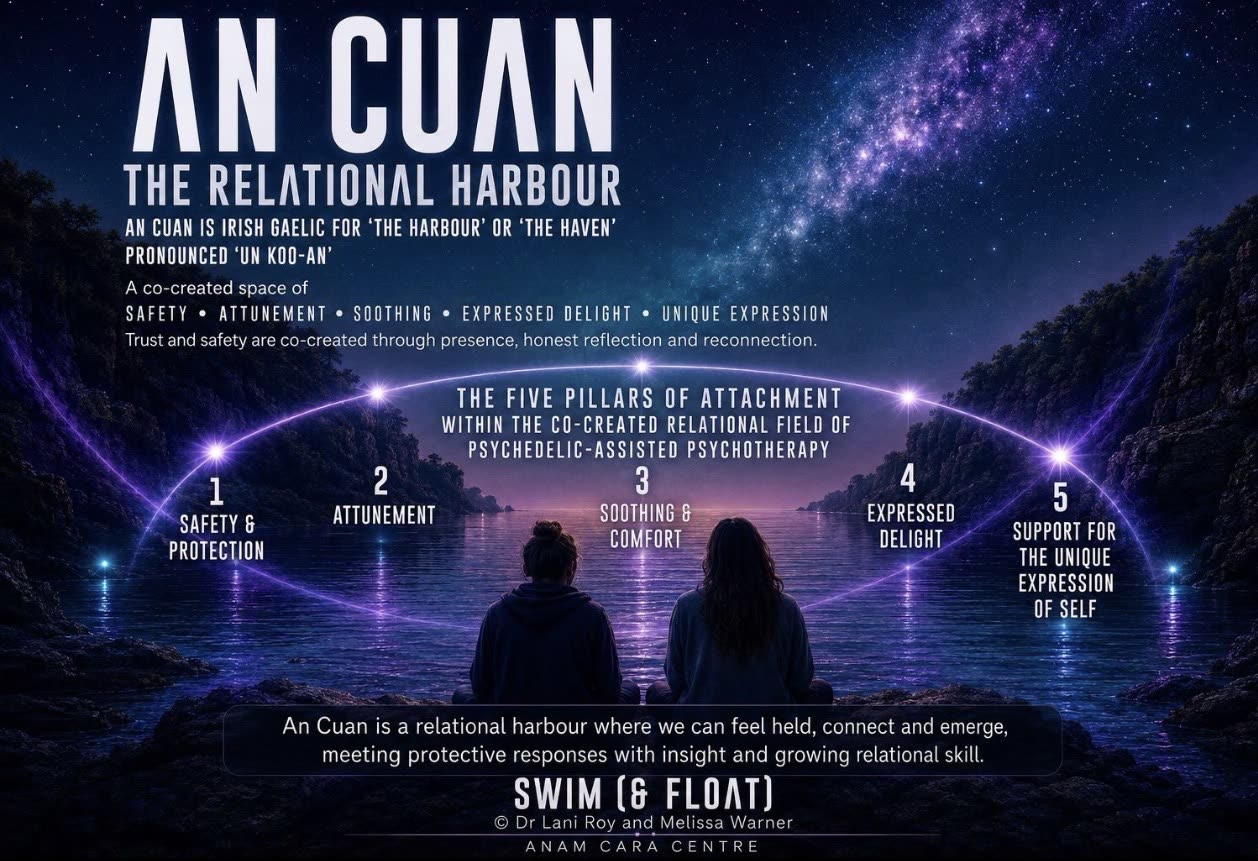
An Cuan (Irish Gaelic for 'the harbour' or 'the haven') is the co-created relational field at the heart of EISP. It is where trust and safety are co-created through presence, honest reflection and reconnection.
EISP actively embodies the Five Pillars of Attachment within the therapeutic relationship:
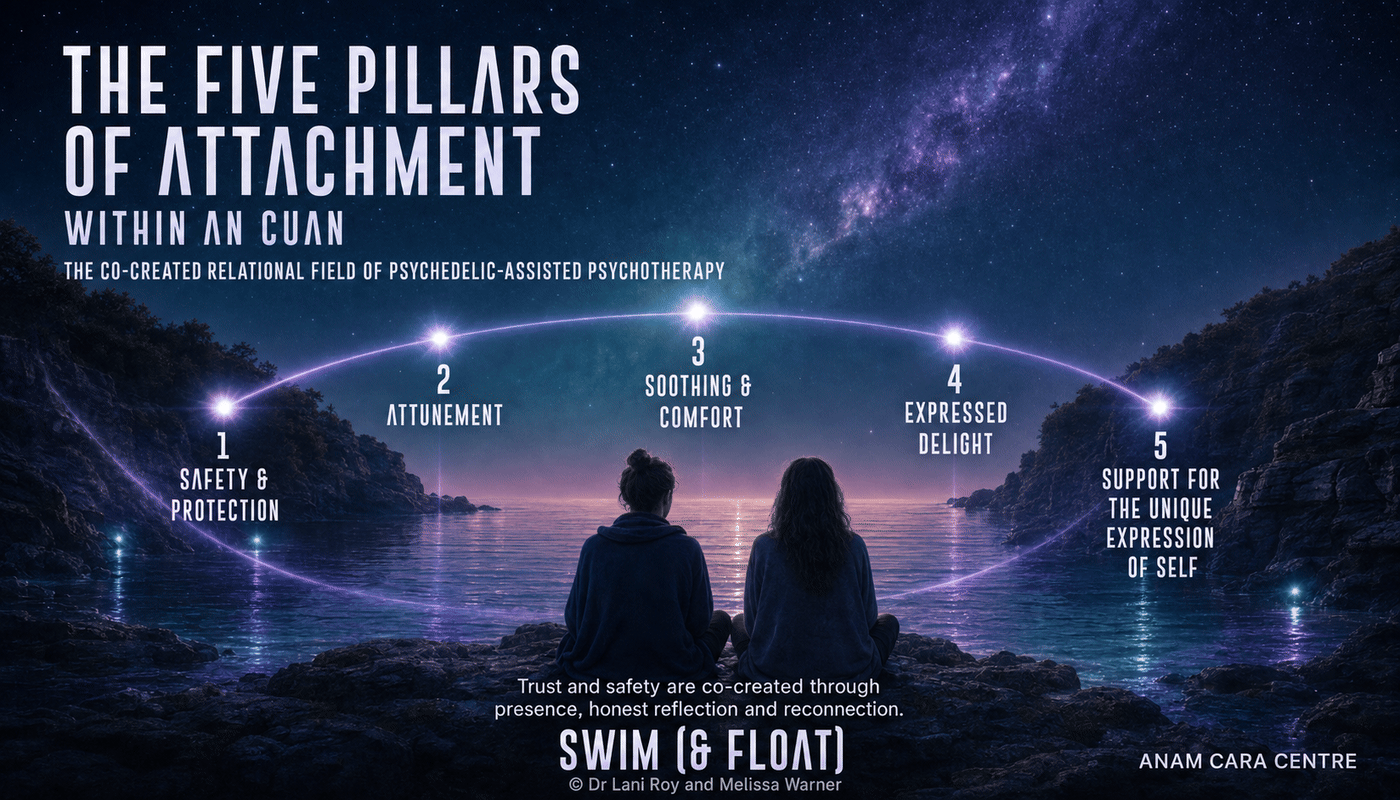
- Safety & Protection: A sense of felt safety
- Attunement: Being seen and known
- Soothing & Comfort: Felt comfort and soothing
- Expressed Delight: Being valued and appreciated
- Support for the Unique Expression of Self: Support for becoming your authentic self
These five pillars create the foundation for exploring deep relational wounding and facilitating nervous system rewiring.
How to get started
Enquire about EISP
Ready to deepen your practice? Learn about our syllabus, next cohort dates, and how EISP training can transform your clinical work.
Mentoring pathways are flexible and tailored to your practice. Dr Lani Roy and our team will discuss timing, structure, and what makes sense for your professional journey.
What you'll develop
This training develops your capacity to hold safe, effective therapeutic space for clients in altered states, whether medicine-assisted or through somatic and relational processes alone. You'll learn to recognise autonomic nervous system states (State 0–4), work with Intentional Response Inhibition and Intrinsic Relational Intelligence (IRI), facilitate nervous system completion, explore transference and projection dynamics, and navigate deep relational work through the therapeutic framework SWIM (Somatic, Wisdom, Interconnectedness, Metacognition).
Upon completion and with appropriate legal frameworks in place, graduates may offer:
- Somatic, attachment-focused psychedelic-assisted therapy, with or without medicine
- Legal psychedelic-assisted therapy within Australia for clients with cannabis or ketamine scripts
- Non-medicine somatic psychotherapy that is relationally focused and somatically precise
- Psychedelic-assisted therapy for clients continuing prescription medications (GP/psychiatrist approved)
Clay, Threshold, Horizon: The Three Landscapes of EISP
Grounded in the Earth, Open to Possibility
The therapeutic journey in EISP moves through three distinct landscapes:
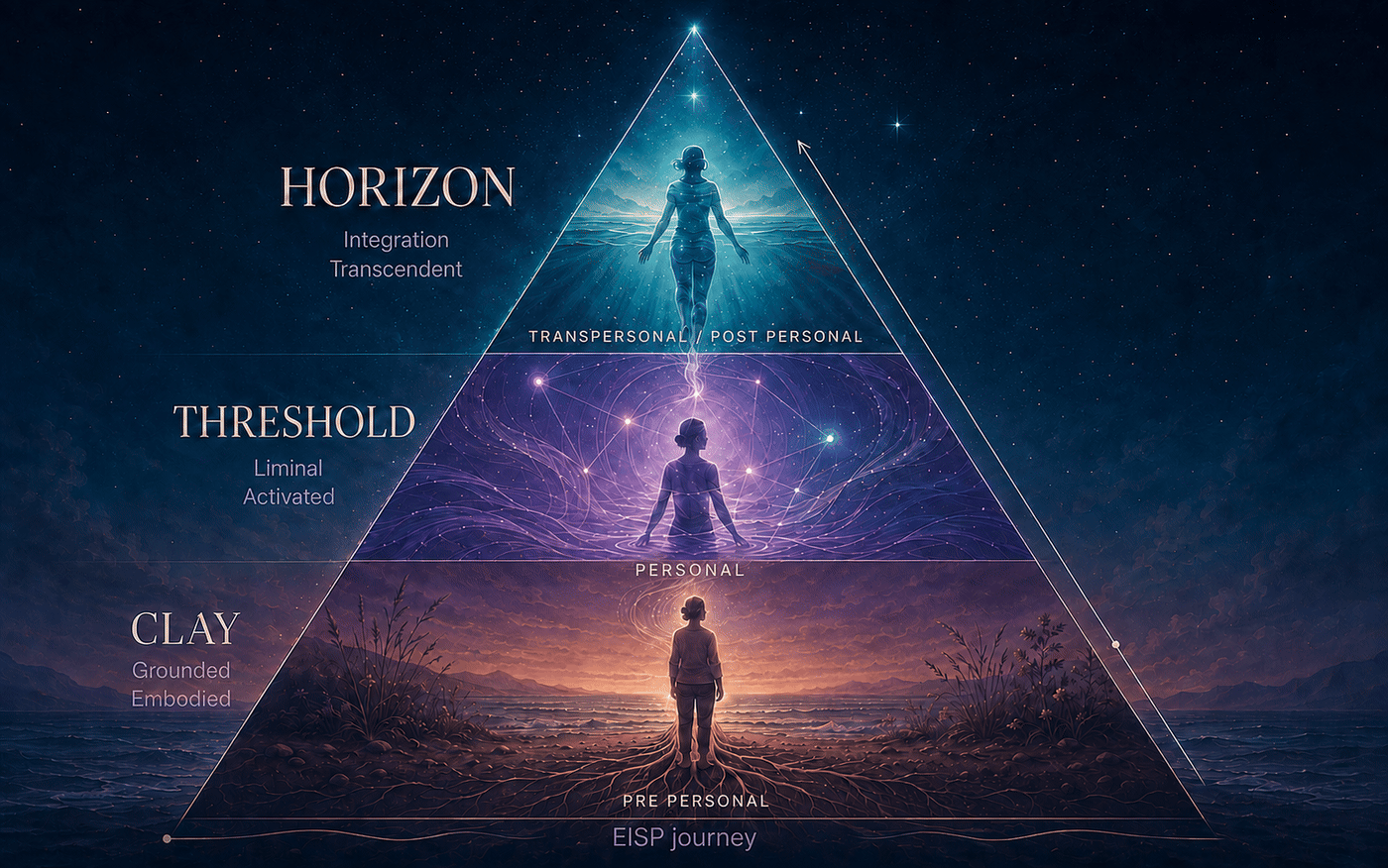
Hover or tap a landscape in the image to explore it.
Clay
The grounded, embodied foundation. Here the work is somatic, rooted, tangible. The nervous system is learning safety through present sensation. This is where protective patterns are tenderly explored and held.
John O'Donohue teaches us: "Your body is made out of clay, so your body is actually a miniature landscape that has got up from under the earth and is now walking on the normal landscape." In EISP, we work with the body as this living landscape, sensing into its terrain, honouring its ancient wisdom. As he writes: "There is something in our clay nature that needs to continually experience this ancient, outer ease of the world. It helps us remember who we are and why we are here."
The clay holds all nervous system responses: the 6 F states (fight, flight, freeze, faint, flock, friend) that arise when the body senses threat or dysregulation. Ideally, the nervous system cycles through these protective responses and returns to homeostasis: to ease, to rest, to the natural state where the clay can settle.
But when clay cannot settle, when the nervous system stays locked in activation or shutdown, trapped in protective patterns that no longer serve, this is where EISP begins. The therapeutic container (An Cuan), the therapist's attunement, the explicit witnessing of these 6 F states, the tracking and gentle support for nervous system completion, all of this is the art of helping the clay find its way back home to ease and regulation.
Threshold
The liminal space where what was known begins to dissolve and what will become is not yet visible. This is where activation, emotion, colour, memory, and relational patterns emerge. The boundary between worlds. Clients often experience intensity, release, emotion, or opening here.
Horizon
The view that opens. Integration, perspective, spiritual recognition, or the felt sense of having moved through something. This is not always "bliss". It is clarity, completion, or the recognition of growth. The horizon recedes as you move toward it, always inviting further becoming.
Most sessions contain all three landscapes. The work begins in Clay (grounded presence), moves through Threshold (activation and opening), and integrates toward Horizon (meaning, perspective, peace, or integration).
Within EISP, the therapist holds space for clients to map their own journey through these landscapes, without forcing the narrative or prescribing what "should" happen.
Requirements
- Current professional registration (AHPRA, PACFA, ACA, AASW)
- Professional indemnity insurance covering psychedelic-assisted therapy
- Mental health stability and capacity for deep relational work
- Commitment to ongoing supervision and professional development
Credentialing and Professional Recognition
Anam Cara graduates may apply for Australian Multidisciplinary Association for Psychedelic Practitioners (AMAPP) credentialing. AMAPP maintains a free market approach to training and credentials individuals based on demonstrated competency and specific policy criteria, regardless of training provider. This means practitioners can choose from multiple accredited training providers across the field while pursuing independent professional credentialing.
AMAPP credentialing is independent of all training organisations and is optional, not required for professional practice.
About This Relationship
Transparency note: Dr Alana Roy, co-director of Anam Cara, is Chair of AMAPP. To be clear: Dr Roy does not sit on the AMAPP credentials team and has no decision-making authority over whether you obtain your credentialing through AMAPP. AMAPP's free market policy is specifically designed to maintain the health of the ecosystem by enabling practitioners to study across diverse training providers while striving to meet and adapt to evolving professional standards.
Learn more: www.amapp.org.au
Deepen your somatic practice
Begin a conversation
EISP mentoring is shaped to your personal and professional path. Dr Lani Roy and our team will help you understand whether this training is the right next step for your practice.
Email: drlaniroy@anamcaracentre.com.au
Phone: 0416 869 823
© EISP™ · Co-created by Dr. Alana (Lani) Roy and Melissa Warner